
Flourishing learning environments – school gardens in the Allgäu
We support school gardens in the Allgäu and neighbouring regions around the foundation's headquarters. These green learning environments and versatile spaces for experimentation foster a new generation of children and young people who act sustainably and consume consciously. They enable valuable first-hand experiences and strengthen the social and personal skills of young people.
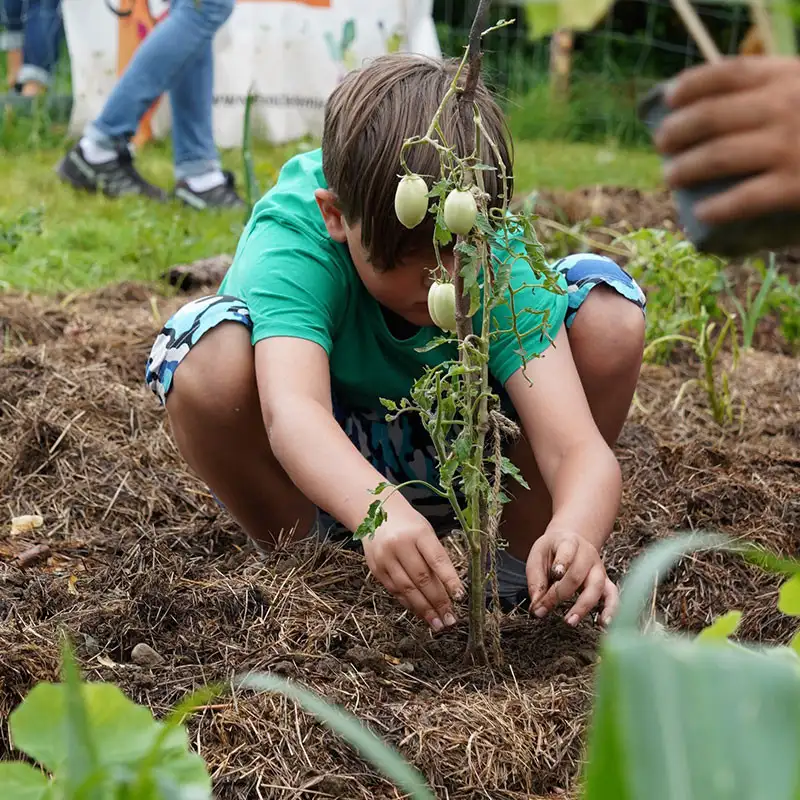
Sustainable development, healthy eating and self-efficacy – school gardens teach all of these things
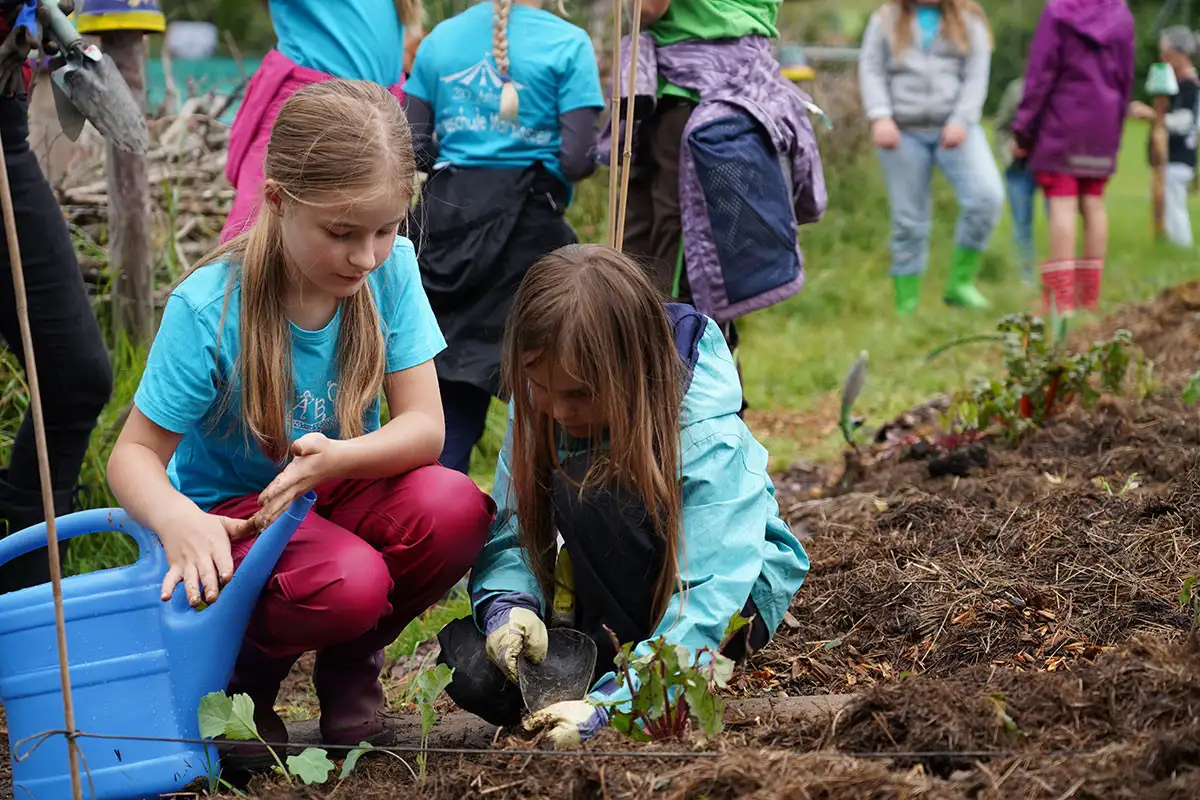
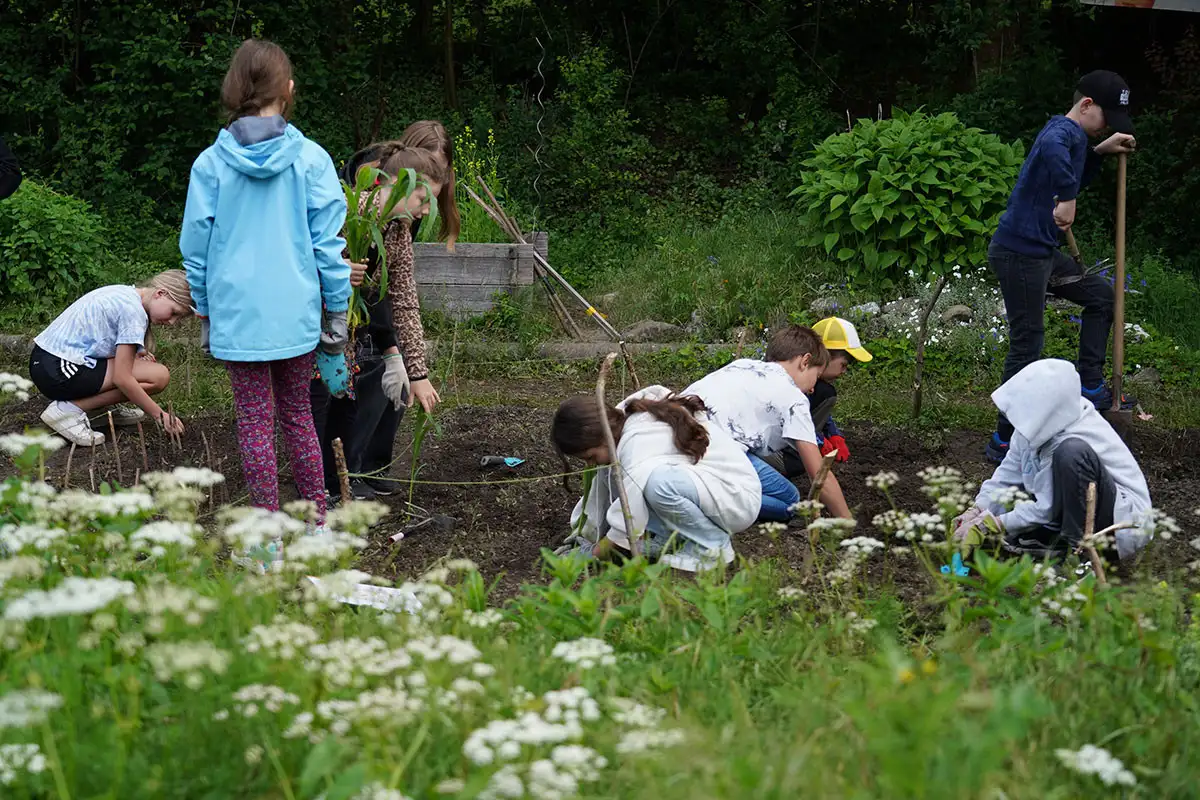
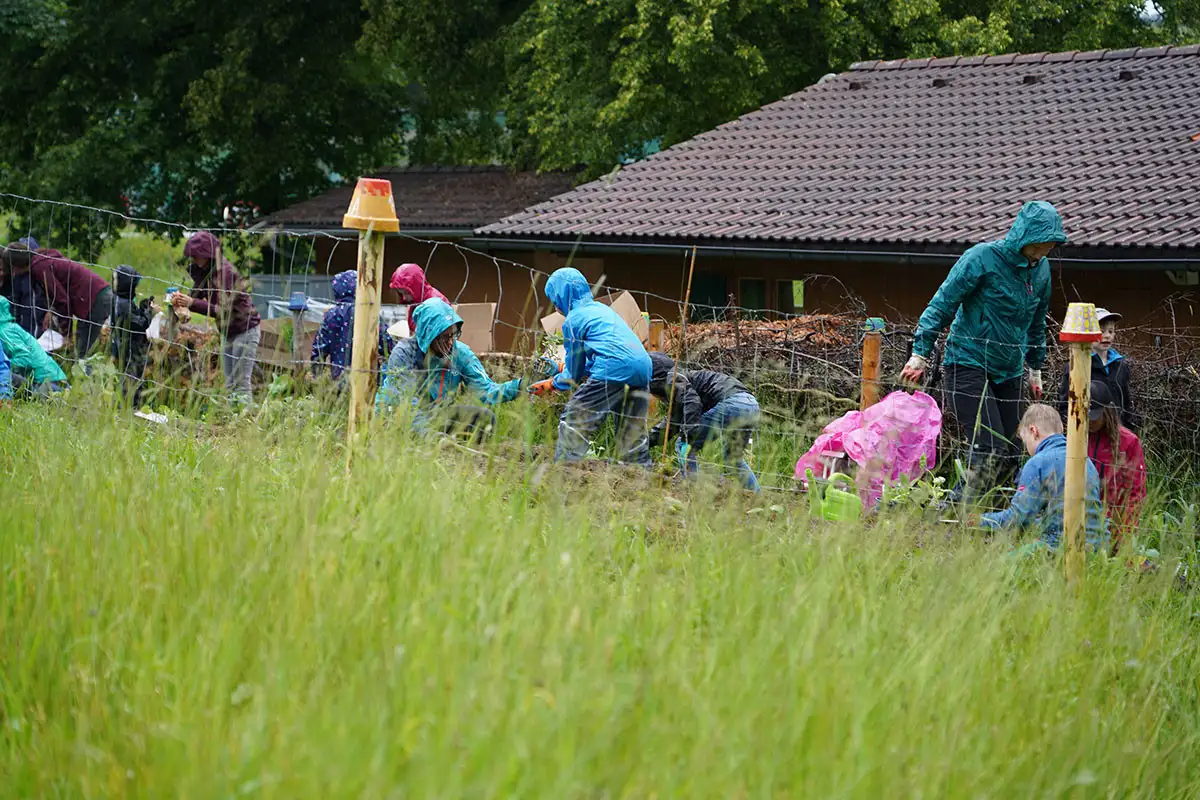
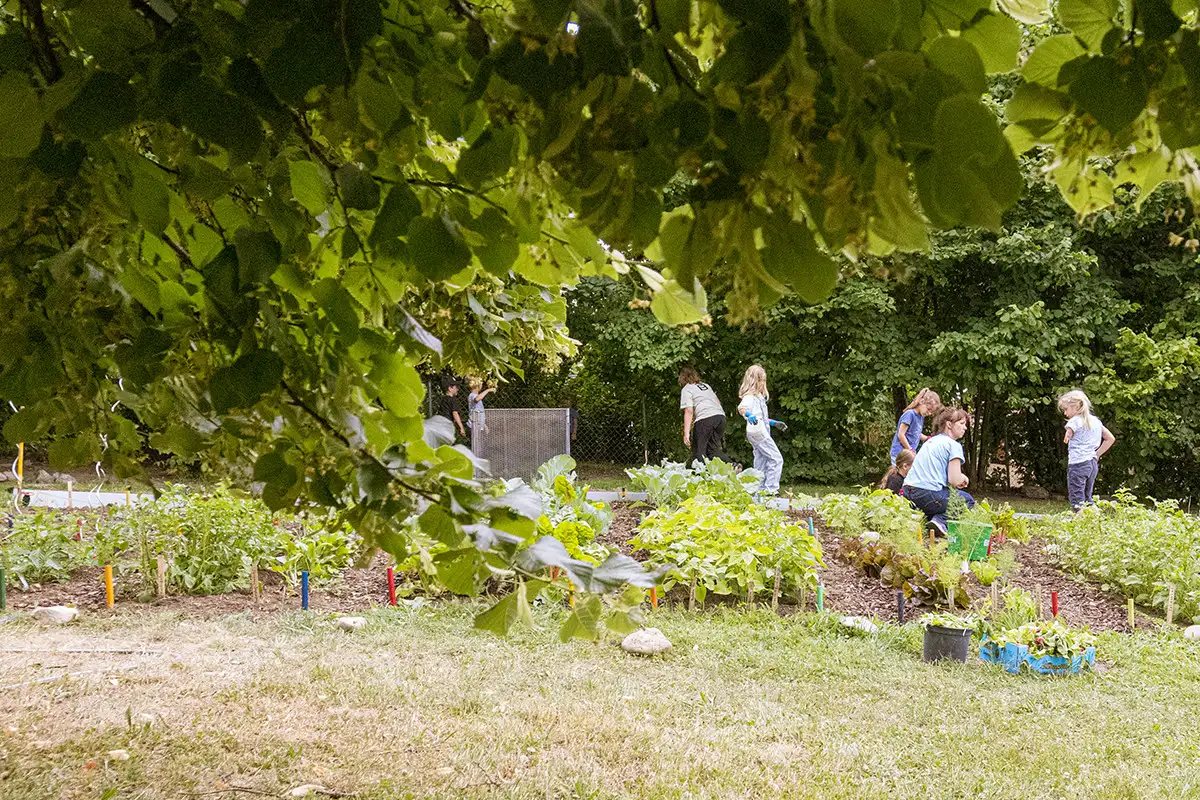
Cucumbers, tomatoes, celery, carrots, fennel and much more. What sounds like a shopping list for the weekly market is actually what grows on the school field. The children are eagerly weeding, harvesting here and there, and in some places already planting for the second time. The fine drizzle doesn't bother anyone, and one girl slides out of her wheelchair onto the ground and eagerly joins in the work. This is the scene at Martinszell Primary School in Oberallgäu in the newly established vegetable garden.
More and more children and young people lack opportunities to experience self-efficacy and a connection to nature. Gardening together promotes social skills and creates new bonds. Appreciation for food is gaining ground, as is education for sustainable development.
The Rapunzel One World Organic Foundation therefore sees its commitment to school gardens as genuine work for the future. “Especially at a time when social media and AI are increasingly guiding us, we believe it is important to also open up other spaces for experience for people, and especially children – very concrete, sensory and at the same time fundamental experiences,” explains Joseph Wilhelm, Chairman of the Executive Board.
More and more children and young people lack opportunities to experience self-efficacy and a connection to nature. Gardening together promotes social skills and creates new bonds. Appreciation for food is gaining ground, as is education for sustainable development.
The Rapunzel One World Organic Foundation therefore sees its commitment to school gardens as genuine work for the future. “Especially at a time when social media and AI are increasingly guiding us, we believe it is important to also open up other spaces for experience for people, and especially children – very concrete, sensory and at the same time fundamental experiences,” explains Joseph Wilhelm, Chairman of the Executive Board.
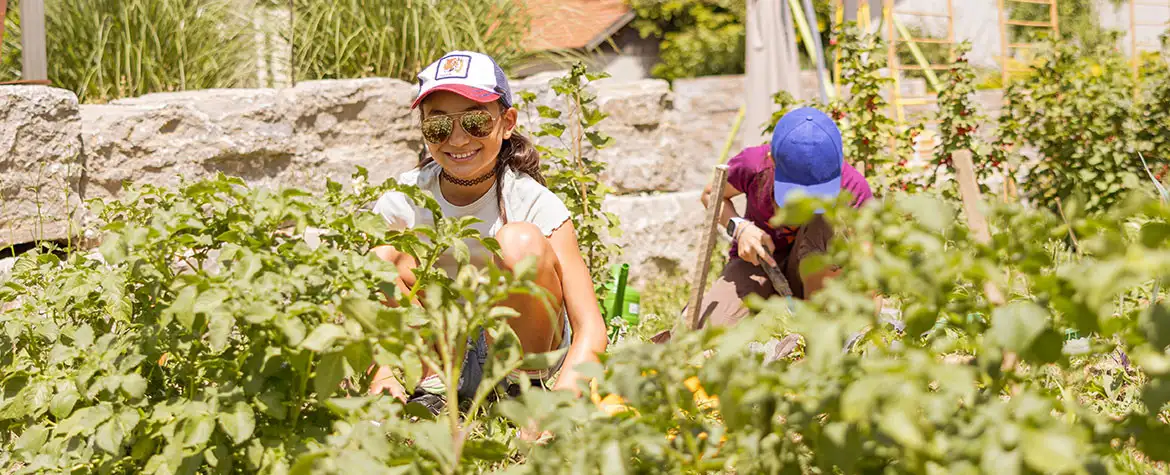
Most children enjoy harvesting, but planting vegetables is also a special experience.
Our help
Funding from the RAPUNZEL One World Organic Foundation enables schools to establish and expand their own vegetable gardens, to cultivate and maintain them, and, last but not least, to integrate them into lessons and school life with a wide range of positive effects.
Thanks to the cooperation between the RAPUNZEL One World Organic Foundation and Acker e.V., several schools in the Allgäu region have been able to set up their own vegetable gardens. The association supports the school gardens for four years so that the schools have enough time to gain experience and knowledge and to establish their gardens at the school. The foundation supports the programme at the participating schools throughout the four years and is available as a regional partner.
We at the Rapunzel One World Organic Foundation provide direct support to other schools in the region. For example, with our support, the Freie Naturschule Ravensburg was able to further develop its newly established school garden as a place of learning.
The Georgenhof near Überlingen on Lake Constance, a children's and youth welfare centre with a school, occupies a prominent position. Here, our funding of personnel and other costs enables regular horticultural lessons for children with mental disabilities or social behaviour disorders.
Other youth facilities also benefit from the support of the RAPUNZEL One World Organic Foundation. For example, Haus Schlegelsberg, a facility for young refugees run by the Johanniter, operates raised beds together with the residents.
We at the Rapunzel One World Organic Foundation provide direct support to other schools in the region. For example, with our support, the Freie Naturschule Ravensburg was able to further develop its newly established school garden as a place of learning.
The Georgenhof near Überlingen on Lake Constance, a children's and youth welfare centre with a school, occupies a prominent position. Here, our funding of personnel and other costs enables regular horticultural lessons for children with mental disabilities or social behaviour disorders.
Other youth facilities also benefit from the support of the RAPUNZEL One World Organic Foundation. For example, Haus Schlegelsberg, a facility for young refugees run by the Johanniter, operates raised beds together with the residents.
This is where the RAPUNZEL One World Organic Foundation provides support
Altusried Primary and Secondary School
Martinszell Primary School, Waltenhofen
Illerbeuren Primary School
Josef Kentenich School, Kempten-Leubas
Elsbethenschule, Memmingen
Haldenwang Primary School
Freie Naturschule Ravensburg e.V. (Ravensburg Free Nature School)
Georgenhof Kinder- und Jugendhilfe mit Schule am Heim nach der Pädagogik Rudolf Steiners e.V. (Georgenhof Child and Youth Welfare Centre with School based on Rudolf Steiner's Educational Philosophy), Überlingen
Wolfertschwenden Primary School
Haus Schlegelsberg, Erkheim, Johanniter-Unfall-Hilfe e.V. (St John Ambulance)




Voices from the school gardens
Foundation: “Ms Wucher, what motivates you to create a school garden?”
Kristina Wucher: “Children today are so far removed from natural cycles, even here in the countryside. And understanding develops through touching...”
Foundation: “Why do you see school as the right place for this?”
Kristina Wucher: “A field like this is like a schoolbook: you have to read, do maths, learn a lot about plants and animals and how to work together as a team.”
Foundation: “And does that work in practice?”
Kristina Wucher: “Oh yes, look at the energy the children put into what they do! At the same time, the children also get to experience how much work goes into producing our food.”
Foundation: “Do you have any other wishes for the garden?”
Kristina Wucher: “Children should learn that food means work. At the same time, I hope that the children will find a little oasis of peace in this garden.”
Interview with Kristina Wucher, headmistress of Martinszell Primary School.
Kristina Wucher: “Children today are so far removed from natural cycles, even here in the countryside. And understanding develops through touching...”
Foundation: “Why do you see school as the right place for this?”
Kristina Wucher: “A field like this is like a schoolbook: you have to read, do maths, learn a lot about plants and animals and how to work together as a team.”
Foundation: “And does that work in practice?”
Kristina Wucher: “Oh yes, look at the energy the children put into what they do! At the same time, the children also get to experience how much work goes into producing our food.”
Foundation: “Do you have any other wishes for the garden?”
Kristina Wucher: “Children should learn that food means work. At the same time, I hope that the children will find a little oasis of peace in this garden.”
Interview with Kristina Wucher, headmistress of Martinszell Primary School.
“The digitisation of our access to the world and media consumption are exacerbating alienation and jeopardising a development that requires the opposite, namely connectivity, wonder, energy, compassion, joy, activity and commitment. With its fields of experience, horticultural education is formative, transformative and sustainable.”
Headmaster Peter Kramer at Georgenhof, Child and Youth Welfare Centre with School at the Home on Lake Constance
Headmaster Peter Kramer at Georgenhof, Child and Youth Welfare Centre with School at the Home on Lake Constance
“I am motivated by the completely different way of working with children. Children can show different qualities.”
Teacher Heike Anwander, Wolfertschwenden Primary School
Teacher Heike Anwander, Wolfertschwenden Primary School
“The harvest is regularly cooked with the children in the school kitchen. This is how we supplement our lunch. The children like it. The salad bowls are emptied as soon as they know it's “their” salad. The courgette fritters are also very popular.”
Julia Friedrich, lunchtime supervision at Haldenwang Primary School
Julia Friedrich, lunchtime supervision at Haldenwang Primary School

Donation account of the
RAPUNZEL One World Organic Foundation
Landesbank Baden-Württemberg
IBAN: DE44 6005 0101 0004 1028 49
SWIFT/BIC: SOLADEST600
Name and address in the reason for payment
learn more